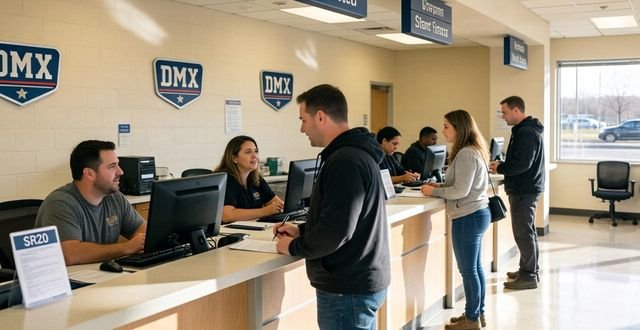
The state of Nebraska mandates a specific form of financial responsibility verification for drivers classified as high-risk. This document, known as SR22 insurance, is not a separate policy but rather a certificate that an insurance provider files with the Nebraska Department of Motor Vehicles (DMV). The necessity for this filing arises from certain driving violations.
A driver may be required to submit an SR22 in Nebraska after convictions such as driving under the influence (DUI), reckless driving, driving without insurance, or accumulating excessive points on their driving record. The causal chain begins with the violation, leading to a court or DMV order, which then triggers the SR22 requirement. The primary purpose of the certificate is to prove that the driver carries at least the state’s minimum liability coverage for a specified period.
Contrast with standard insurance requirements
In most states, including Nebraska, a typical driver simply maintains proof of insurance without any additional filing. However, the SR22 serves as a monitoring tool. While standard policies only require verification at traffic stops or accidents, the SR22 mandates that the insurance company notify the DMV immediately if the policy lapses, is canceled, or is not renewed. This heightened level of accountability distinguishes the high-risk driver from the general population.
For example, a driver in Omaha with a clean record can switch insurers without any state intervention. In contrast, a driver in Lincoln with a DUI conviction who allows their SR22-backed policy to expire will trigger an automatic license suspension and reset the mandatory filing period.
Cost structure and influencing factors
The expense associated with obtaining SR22 insurance in Nebraska is not a single flat fee but rather a combination of the filing fee and the increased premium for high-risk coverage. Insurance providers typically charge a one-time filing fee ranging from $25 to $50 to submit the SR22 form to the Nebraska DMV. The more substantial cost comes from the liability premium itself.
| Factor | Impact on Annual Premium (Estimated) |
|---|---|
| DUI conviction (first offense) | +$400 – $800 |
| Reckless driving | +$300 – $600 |
| Prior lapse in coverage | +$200 – $500 |
| Young driver (under 25) | +$500 – $1,200 |
A 2021 analysis of Nebraska insurance data indicated that drivers requiring an SR22 pay, on average, 60% to 80% more than standard policyholders. The exact premium depends on the driver’s age, exact violation, driving history before the incident, and the chosen insurance carrier. Non-owner SR22 policies, intended for individuals who drive but do not own a vehicle, are generally cheaper because they exclude physical damage coverage for a specific car.
Step-by-step process for obtaining SR22 in Nebraska
Step 1 – Determine the required duration. The Nebraska DMV typically mandates SR22 filing for three years from the date of license reinstatement. A DUI conviction may extend this period or require additional conditions.
Step 2 – Contact multiple insurance providers. Not all companies offer SR22 filings. Specialized high-risk insurers or larger national carriers often provide this service. Request quotes that explicitly state the SR22 filing fee and the monthly or annual premium.
Step 3 – Purchase the policy and authorize filing. After selecting an insurer, the driver must pay the initial premium and the filing fee. The insurer then electronically submits the SR22 certificate to the Nebraska DMV.
Step 4 – Verify with the DMV. The driver can check their driving record online or by mail to confirm that the DMV has received and accepted the filing. Without this confirmation, the driver may still be considered non-compliant.

Step 5 – Maintain continuous coverage. Any gap, even a single day without payment, triggers a notice to the DMV. The driver must then restart the entire three-year period from the date of reinstatement after the lapse.
Common misconceptions and empirical evidence
A frequent error among Nebraska drivers is believing that an SR22 is a type of high-limit policy. In reality, the certificate does not increase coverage limits; it only certifies that the minimum required limits are active. Nebraska’s minimum liability limits are 25/50/25 – $25,000 for bodily injury per person, $50,000 for bodily injury per accident, and $25,000 for property damage.
Another misconception involves the assumption that moving to another state cancels the Nebraska SR22 requirement. Experimental evidence from interstate compact data shows that the home state (Nebraska) retains jurisdiction. The driver must continue filing an SR22 with Nebraska even after establishing residency elsewhere, unless the Nebraska DMV issues a formal release.
Dialogue between a driver and an insurance agent
Driver: “I just moved to Nebraska from Iowa. My license is suspended here because of a DUI in 2024. Do I need an SR22 from a Nebraska company or can I use my old Iowa policy?”
Agent: “You must obtain a Nebraska insurance policy that files an SR22 with the Nebraska DMV. An out-of-state SR22 does not satisfy Nebraska’s requirement because each state’s DMV maintains separate databases. However, if your Iowa policy is still active, you can request that your Iowa insurer file an SR22 on your behalf with Nebraska – many insurers can do this through multistate filing systems. But the certificate must be addressed to the Nebraska DMV.”
Regional specificities within Nebraska
While state law governs SR22 uniformly, local practices vary. In rural areas such as the Panhandle (e.g., Scotts Bluff County), fewer insurance agents specialize in high-risk filings, leading to longer processing times – up to 10 business days for paper filings. In urban centers like Omaha or Lincoln, electronic filings typically complete within 48 hours. Additionally, some counties require a court-ordered proof of SR22 before allowing restricted driving privileges, whereas others accept the DMV notification alone.
Trends and future outlook
The Nebraska Legislature has considered replacing the SR22 system with an electronic monitoring program that uses telematics. A 2025 pilot study in Douglas County tested whether continuous GPS-based driving behavior tracking could replace the static SR22 certificate. Preliminary results showed a 30% reduction in repeat offenses among monitored drivers, but privacy concerns halted expansion. For the foreseeable future, the SR22 remains the standard.
Return to the initial scenario
Thus, a driver who receives a DUI conviction in Nebraska faces a clear sequence: the violation causes a license suspension, which can only be lifted by filing an SR22 for three continuous years. Any lapse resets the clock. The costs, while significant, are avoidable only through perfect compliance. By understanding the causal relationships – from violation to filing to reinstatement – drivers can navigate the process without unnecessary delays. The system, though demanding, serves the state’s goal of ensuring that high-risk drivers maintain financial responsibility.
No Comments
Be the first to share your thoughts on this article.