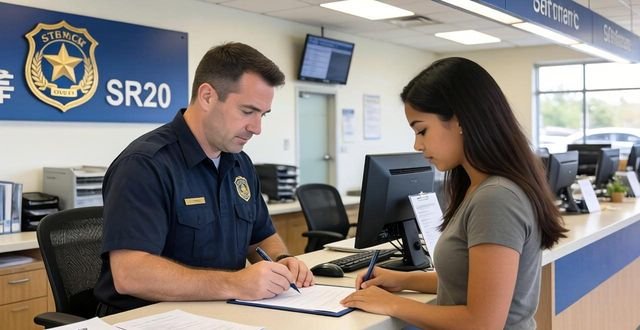
A driver sits in a cold DMV waiting room.
A letter arrives: “Your license will be suspended in thirty days.”
The cause? A serious traffic violation. No proof of future financial responsibility.
Thus begins the search for SR22 insurance traffic coverage.
I. The Certificate, Not the Policy
SR22 is a filing. Not an insurance product.
A surety bond or liability policy, certified by state authorities.
Proof of minimum liability coverage. Nothing more.
Filed directly by the insurer with the DMV.
> “A mere document,” says the law. Yet without it, no driving privilege.
II. The Trigger: How You Arrive Here
Events that demand the SR22:
Driving Under the Influence (DUI) or Driving While Intoxicated (DWI).
Reckless driving causing bodily harm.
Driving without insurance, repeatedly.
Accumulation of excessive points on the driving record.
At-fault accident without coverage.
Each violation narrows the road.
III. The Filing Process: Three Paths
Owner filing — for those who own a vehicle.
Operator filing — for those who drive but own no car.
Owner-operator filing — covers both personal and borrowed vehicles.
The insurer submits the certificate.
The state receives it digitally.
The clock starts: typically three years.
IV. The Cost Landscape
Base filing fee: $25 to $50, one-time.
Monthly premium increase: 150% to 300% above standard rates.
Real examples:
| Violation Type | Average Monthly SR22 Premium |
|---|---|
| Single DUI | $150–$350 |
| Reckless driving | $100–$250 |
| No-insurance ticket | $80–$180 |
| Multiple violations | $200–$500+ |
Non-owner policies: lower, but still elevated.
V. State Variations: A Patchwork of Rules
California: SR22 required for three years after DUI.
Texas: SR22 for two years. Non-owner filing common.
Florida: FR44 for high-BAC cases — higher limits than SR22.
New York: Equivalent is FS-20 or FS-21, not SR22.
Virginia: Uninsured motorist fee plus SR22 for suspension release.
> One state’s certificate is another state’s foreign filing.
Move across borders? The new DMV will ask for your SR22 history.
VI. The Consequence of Lapse
A single missed payment.
A policy cancellation notice.
The insurer must notify the DMV within ten days.

Result: Immediate license suspension.
The three-year clock resets.
Higher premiums upon reinstatement.
VII. Dialogue: Agent and Driver
Driver: “Can I drive in another state with this filing?”
Agent: “Yes. Most states honor foreign filings. Inform your insurer before moving.”
Driver: “What if I sell my car?”
Agent: “Switch to a non-owner SR22. Lapse the policy only after the mandatory period ends.”
Driver: “How to reduce costs?”
Agent: “Maintain a clean record for twelve months. Then requote. Take a defensive driving course. Bundle with renters or other policies.”
VIII. The Long View: From Burden to Compliance
First year: High premiums. Frequent verification. Anxiety at each renewal.
Second year: Rates may drop 15–30%. The filing remains active. Driving habits improve.
Third year: Final stretch. No new violations. The end date approaches.
After expiration: Certificate automatically removed. Standard insurance rates return. Driving record still carries the violation, but the mandate lifts.
IX. A Case Study in Contrast
John, California: DUI in 2024. SR22 filing for three years. Premium: $220/month for first year. Non-owner after selling car. Total cost: $7,920 over three years.
Maria, Texas: Two no-insurance tickets in 2025. Two-year SR22 requirement. Premium: $140/month. Total: $3,360. No further violations. Returned to standard rates in 2027.
David, Florida: High-BAC DUI. Required FR44 — $300,000 liability limit vs. standard $10,000. Premium: $450/month. Three-year mandate. Total: $16,200.
The same certificate, radically different burdens.
X. The Final Traffic Stop Analogy
A police officer runs your license plate.
The system shows: “SR22 compliant — active.”
Status: Legal.
Risk: Managed.
Future: Contingent on today’s choices.
The certificate is not punishment. It is surveillance. A promise extracted by the state, enforced by insurers, paid by the driver.
XI. Practical Guidance for the Compliant Driver
Do not cancel any auto policy without a replacement in place.
Request a renewal notice confirmation from your insurer each period.
Keep a digital copy of the SR22 certificate in your vehicle.
After the mandated period ends, request a removal confirmation from the DMV.
Compare quotes annually — some insurers raise rates arbitrarily.
XII. Closing the Circle
That driver in the DMV waiting room?
He now holds a stamped certificate.
He pays higher premiums.
He drives with caution.
Two years remain on his filing.
But tonight, he will drive home legally.
The road accepts him — conditionally, warily, but without further penalty.
For now.
And so the SR22 insurance traffic coverage remains what it has always been: a ledger of past error, a key to present mobility, and a bond for future compliance.
No Comments
Be the first to share your thoughts on this article.